- Crew Notes
- Posts
- I Hated Christmas (And Jonah Hated Mercy)

I hated Christmas.
Not the idea of it. Not the carols or the lights or the family gathering around the table. I loved all that.
I hated Christmas Day itself.
I'm was an only child for most of my childhood. My mom didn't believe in giving gifts on Christmas. Her reason was simple: "It's Jesus' birthday. Other people don't get gifts on your birthday."
I said I was okay with that. I thought I was.
But I'm the fifth oldest of 32 cousins. Around Christmas time, when we all got together, I had to sit there and watch my little cousins open present after present. Year after year.
See, none of my aunts and uncles had the same philosophy. So my cousins had piles of toys. The neighbor kids too. It was a tradition—all the kids would come outside Christmas afternoon and compare what they got.
I was always silent.
So my heart grew cold. I loved the family time, the food, the laughter. But Christmas Day? I hated it.
As an adult, I made sure my kids had presents. But it didn't heal anything. I was happy for them, but it just reminded me of my pain.
So I ran. Away from Christmas. Away from the feeling. Away from the jealousy I didn't recognize until years later, when I was in the military and physically away from my family.
That's when I realized how deep it went.
Jonah Ran Too
Jonah was a prophet who knew exactly how gracious God was. He knew God would show mercy to people who didn't deserve it.
And at some point, he couldn't stand it anymore.
Jonah 4:2 (NKJV):
"So he prayed to the Lord, and said, 'Ah, Lord, was not this what I said when I was still in my country? Therefore I fled previously to Tarshish; for I know that You are a gracious and merciful God, slow to anger and abundant in lovingkindness, One who relents from doing harm.'"
God told Jonah to go to Nineveh and warn them. To give them a chance to repent—to turn away from their sin and back to God.
But Nineveh was the capital of Assyria. Not just an enemy—the enemy. The nation that attacked Israel. Oppressed them. Wanted them wiped off the map.
Jonah didn't want them to repent. He wanted them to rot.
So he ran. Got on a boat headed in the opposite direction. Tried to outrun the assignment.
Because deep down, he knew: if he went to Nineveh and preached, they might actually listen. And if they listened, God might actually forgive them.
And that felt unbearable.
The Anger We Don't Talk About
People who grew up in church sometimes develop cold hearts. Because we watch others receive grace—unearned favor from God—that we think they didn't deserve.
They didn't have to go to church all day as kids. They didn't have to sacrifice. They didn't follow the rules while everyone else was out there living.
We see this tension all through the Bible.
The brother of the prodigal son—Luke 15:29-30:
"So he answered and said to his father, 'Lo, these many years I have been serving you; I never transgressed your commandment at any time; and yet you never gave me a young goat, that I might make merry with my friends. But as soon as this son of yours came, who has devoured your livelihood with harlots, you killed the fatted calf for him.'"
The workers who started at 6am got the same pay as those who showed up an hour before quitting time—Matthew 20:12:
"These last men have worked only one hour, and you made them equal to us who have borne the burden and the heat of the day."
It feels unfair.
And here's the thing: there's no Hebrew word for "fair."
Which means when the Bible was written, the concept wasn't even on God's radar. Justice? Yes. Mercy? Absolutely. But fairness—the idea that everyone should get exactly what they earn—that's all us. That's human thinking, not God's.
We want people to get what they deserve. We want our struggles to matter more. We want to be special because we did it right.
But grace doesn't work that way.
God's Two Questions
The whole book of Jonah is written as satire. Everything's backwards. The "pagan" sailors pray while the "prophet" sleeps. The "wicked" city repents while the "righteous" man stays bitter. It's a mirror showing us that sometimes the people who know God best act the least like Him.
Jonah preached to Nineveh. They repented. God spared them. And Jonah was furious.
Then God asked him a question.
Jonah 4:4 (NKJV):
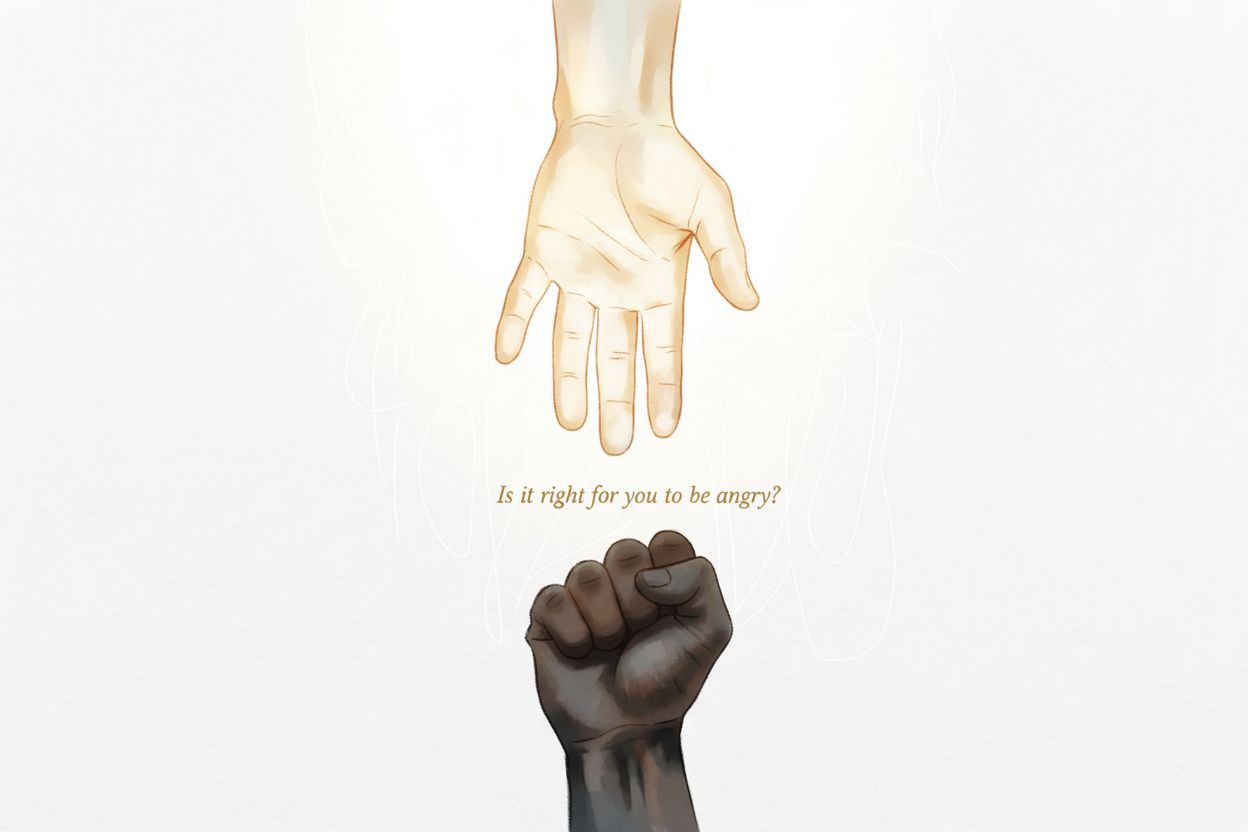
"Then the Lord said, 'Is it right for you to be angry?'"
Jonah didn't answer. He sat outside the city, hoping God would change His mind and destroy them anyway.
Later, God asked again:
Jonah 4:9 (NKJV):
"Then God said to Jonah, 'Is it right for you to be angry about the plant?' And he said, 'It is right for me to be angry, even to death!'"
Jonah said yes. He was so mad he wanted to die.
But God wasn't done.
Jonah 4:10-11 (NKJV):
"But the Lord said, 'You have had pity on the plant for which you have not labored, nor made it grow, which came up in a night and perished in a night. And should I not pity Nineveh, that great city, in which are more than one hundred and twenty thousand persons who cannot discern between their right hand and their left—and much livestock?'"
God's point: You're angry about a plant you didn't create, didn't water, didn't grow. But I should destroy 120,000 people—people who don't even know right from wrong—because you think they don't deserve mercy?
The book ends there. No resolution. No answer from Jonah.
Because the question isn't for Jonah.
It's for us.
What I Learned Writing a Christmas Album
I wrote a Christmas album recently. The process forced me to think about all the good moments. The family. The laughter. The food. The abundance that was there, instead of obsessing over what wasn't.
Then I read Jonah right after finishing it.
That's when it clicked.
I saw myself in him.
I'd been focusing on what I didn't get. On the presents my cousins opened while I sat there silent. On the unfairness of it all.
But I'd missed everything else. The family that showed up. The meals we shared. The fact that I was never alone.
I had abundance. I just couldn't see it because I was too busy keeping score.
Check Your Heart
God asked Jonah twice if it was right for him to be angry.
I think He's asking us the same thing.
Jonah's anger wasn't righteous. It was bitter. Self-righteous—thinking he was better than everyone else because he followed the rules. He thought he deserved more because he'd worked harder.
But here's the truth: we're all saved by grace. We've all fallen short.
My sin isn't better than someone else's just because I sinned differently. All of it separates us from God. But our human brains want to rank it. To say, "Mine wasn't as bad."
But bad is bad.
If grace is truly grace, then none of us deserve it. Not me. Not you. Not the prodigal. Not Nineveh.
That's the whole point.

The Mirror
The book of Jonah ends without an answer because it's not Jonah's story to finish.
It's ours.
God’s mercy isn’t an insult. It’s an invitation to stop measuring, stop scorekeeping, and stop chasing what we think we deserve.
Jonah wanted his enemies to die. God wanted them to live.
I wanted Christmas to validate me. God wanted me to notice what was already there.
Jonah’s story ends open because the question is ours to answer:
“Is it right for you to be angry?”
I’m not angry at my mom. She did what she knew.
But I had to release the bitterness, the keeping score, the belief that my pain made me unique.
The question isn’t who deserves grace.
It’s whether you can celebrate it when they get it.
Whether you can live grateful even when someone’s story looks different.
Whether you can stop counting and rest in the mercy already covering you.
Everyone struggles—just differently.
So my answer is simple:
No, it’s not right for me to be angry.
What’s your answer to God’s question?
That’s it for today
keep JOY, live Disciplined

Reply