- Crew Notes
- Posts
- The Miracle at Cana Wasn't About the Wine

Someone sent me a message after reading my post about the prodigal son:
"Hey Cali, I saw your post on the prodigal son on Threads yesterday. Thank you so much for sharing! Hope you're doing great? I don't know if it's okay to ask your opinion about another story—the wedding at Cana. Were the stone jars completely empty before Jesus told the servants to fill them up? Or did they already have some level of water in them—given that they were used for Jewish purification? I hope you get to see this and that the spirit of God gives you deeper insight. Many thanks!"
Great question.
And honestly, I'd never thought about it that deeply before.
I was listening to a sermon from a preacher I've been following for years. And he said something about the Cana miracle I'd never heard him teach before.
God is super good.
The miracle at Cana wasn't really about turning water into wine.
It was about keeping a family from walking in shame.
The Question: Were the Jars Empty?
Let's start with what the text actually says.
John 2:6-7 (NKJV):
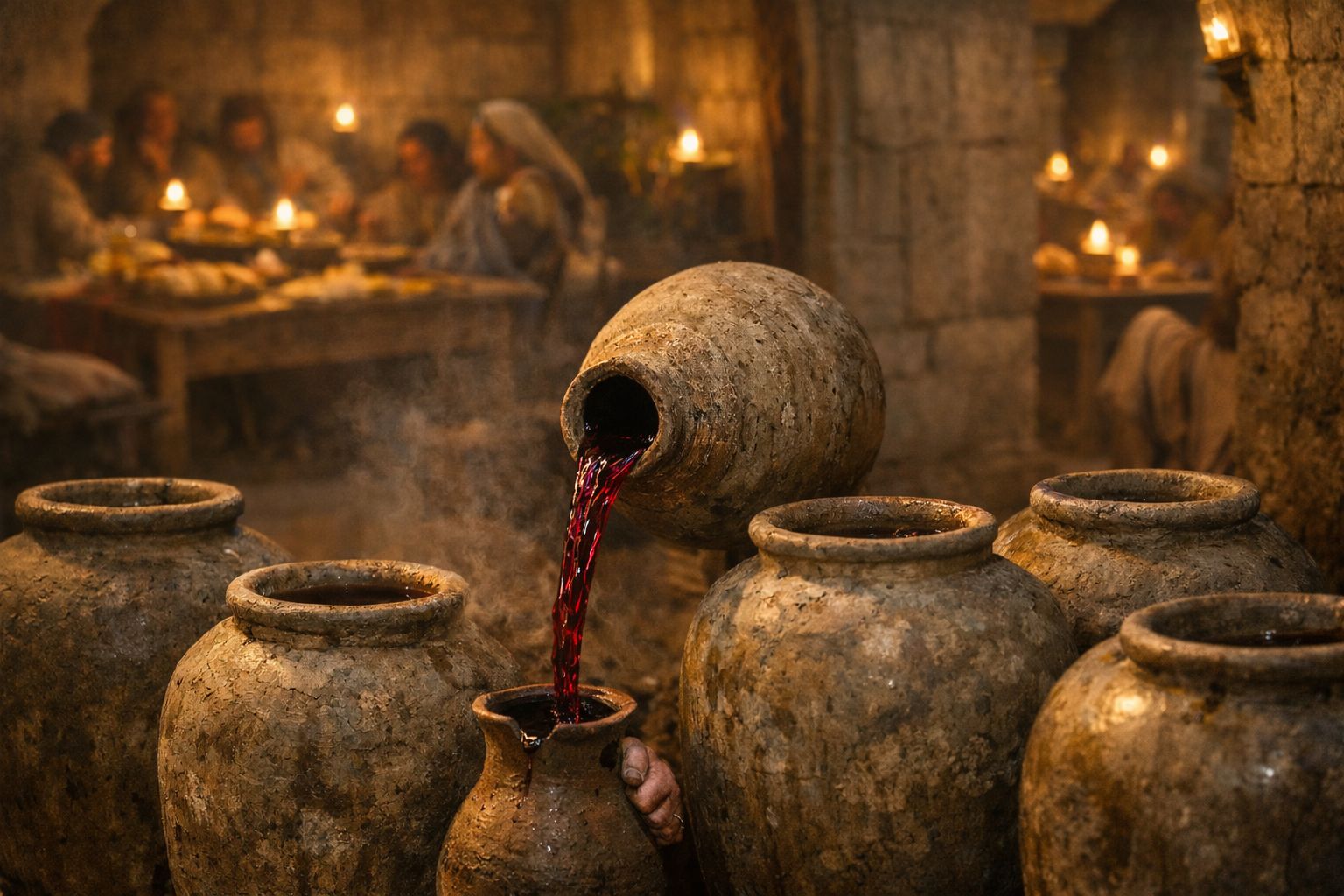
"Now there were set there six waterpots of stone, according to the manner of purification of the Jews, containing twenty or thirty gallons apiece. Jesus said to them, 'Fill the waterpots with water.' And they filled them up to the brim."
The jars were used for Jewish ceremonial washing. Guests would wash their hands before meals as part of ritual purification. These weren't decorative—they were functional, and they were stone because stone couldn't become ceremonially unclean.
The text doesn't explicitly say the jars were empty. But it does say the servants "filled them up to the brim."
So whether they had some water in them already or not, the point is this: Jesus used what was meant for ceremonial washing and turned it into something that brought joy and saved a family from shame.
Each jar held 20 to 30 gallons. Six jars total.
That's 120 to 180 gallons of wine.
Jesus didn't just fix the problem. He gave them abundance.
What Was Really at Stake
To understand why this miracle mattered, you have to understand Jewish wedding customs in first-century Galilee.
Weddings didn't last a few hours. They lasted seven days. Sometimes longer for wealthier families.
The entire community was invited. And the groom's family was responsible for providing food and wine for the entire celebration.
Running out of wine wasn't just embarrassing.
It was catastrophic.
The family could be sued for breach of hospitality obligations. The shame wouldn't just last a week—it would follow them for generations. Their family name would be associated with failure. Future business dealings, marriages, and community standing would all be affected.
In that honor-shame culture, this wasn't a "whoops" moment. It was a permanent stain.
And wine wasn't just a beverage. It symbolized joy, blessing, and God's provision. Psalm 104:15 says wine "makes glad the heart of man."
A wedding without wine was a wedding without blessing. It suggested the family was either poor, unprepared, or cursed.
So when Mary came to Jesus and said, "They have no wine" (John 2:3), she wasn't making small talk.
She was saying: This family is about to be ruined.
Jesus' response is interesting.
John 2:4 (NKJV):
"Jesus said to her, 'Woman, what does your concern have to do with Me? My hour has not yet come.'"
He wasn't being rude. He was saying, This isn't the time for Me to reveal Myself publicly.
But Mary knew Him. She knew His heart. So she told the servants, "Whatever He says to you, do it" (John 2:5).
And Jesus did it.
Not because it was His time. Not because He was ready to go public. But because His mother asked Him.
Proximity and relationship moved Him.
He turned the purification water into wedding wine. Somewhere between 120 and 180 gallons of it. The best wine anyone at that wedding had ever tasted.
But here's what most people miss:
Nobody knew.
John 2:9-10 (NKJV):
"When the master of the feast had tasted the water that was made wine, and did not know where it came from (but the servants who had drawn the water knew), the master of the feast called the bridegroom. And he said to him, 'Every man at the beginning sets out the good wine, and when the guests have well drunk, then the inferior. You have kept the good wine until now!'"
The master of the feast didn't know. The bridegroom didn't know. The guests didn't know.
Only the servants knew. And Mary. And the disciples.
It was a hidden miracle.
Sometimes the work God does in your life is between you and Him. But others will see the fruit.
The family was saved from shame. But they didn't even know it was Jesus who saved them.
The First Miracle and the Last Miracle
This was Jesus' first miracle.
And when you understand what it was really about, you start to see a pattern.
Because His last miracle in the Gospel of John was about the same thing.
Shame. Relationship. Proximity.
After Jesus rose from the dead, Peter went back to fishing. He'd denied Jesus three times. And in Jewish culture, denying your rabbi—your teacher—wasn't just a mistake.
It was shameful.
We think of it in modern terms. Like, "I don't know that guy." And it's whatever.
But in first-century Judaism, a disciple's identity was completely tied to their teacher. To deny your rabbi was to break covenant. It was spiritual betrayal.
Peter didn't just lie. He cursed and swore that he didn't know Jesus (Matthew 26:74). And after the rooster crowed, he "wept bitterly" (Luke 22:62).
He went back to fishing (John 21:3). Essentially saying, I'm done. I'm disqualified.
But Jesus didn't leave him there.
John 21:15-17 records the moment Jesus pulled Peter aside. Privately. On the beach. After cooking him breakfast.
And He asked him three times: "Do you love Me?"
Three questions. Mirroring the three denials.
Each time Peter said yes, Jesus gave him a new commission:
"Feed My lambs."
"Tend My sheep."
"Feed My sheep."
Jesus didn't shame him. He restored him to purpose.
The miracle wasn't just the catch of fish. The miracle was bringing Peter from shame back into relationship.
Peter had broken covenant. Jesus renewed it.
Peter had denied proximity. Jesus restored it.
The Theme of the Whole Bible
This is what I've been learning all year.
The Bible isn't just a collection of stories. It's one story.
It's about a King and His Kingdom. It's about relationship and proximity.
In the Garden of Eden, God walked with Adam and Eve "in the cool of the day" (Genesis 3:8). That was daily intimacy. The protected place of pleasure. God dwelling with them.
Sin broke that proximity. They were driven out, and cherubim with a flaming sword blocked the way back (Genesis 3:23-24).
But God didn't give up.
Exodus 25:8 (NKJV):
"Let them make Me a sanctuary, that I may dwell among them."
The Tabernacle. The Temple. God's goal wasn't just to be worshiped from a distance. It was to be near His people.
Then Jesus came.
John 1:14 (NKJV):
"And the Word became flesh and dwelt among us."
The Greek word is eskenosen—literally "tabernacled" among us. Jesus = God moving back into the neighborhood.
And at the end of all things:
Revelation 21:3 (NKJV):
"Behold, the tabernacle of God is with men, and He will dwell with them, and they shall be His people. God Himself will be with them and be their God."
Paradise. Paradise Lost. Paradise Restored.
The entire Bible is God trying to restore what sin broke: relationship and proximity.
We can all see it. Romans 1:20 says His invisible attributes are clearly seen, understood by the things He made, so we're all without excuse.
And we all have a choice.

Choose Wisely
I started this newsletter as a way to write out and express the things I'm reading and learning while reading the Bible every day.
This is the last article of 2025.
And it feels fitting that the culmination of everything I've learned this year comes down to this:
It's all about relationship and proximity.
Jesus' first miracle: He protected a family from shame because His mother asked Him. Relationship moved Him.
Jesus' last miracle: He restored Peter from shame because He refused to let broken covenant be the final word. Proximity healed him.
The question isn't whether God wants relationship with you.
The question is whether you'll step close.
He's been reaching for you since Eden. He became flesh to dwell with you. He's inviting you into proximity right now.
All you have to do is say yes.
Happy New Year. Talk to you in 2026.
keep JOY, live Disciplined

Reply