- Crew Notes
- Posts
- The World Wants You to Be a Brick. God Made You a Stone.

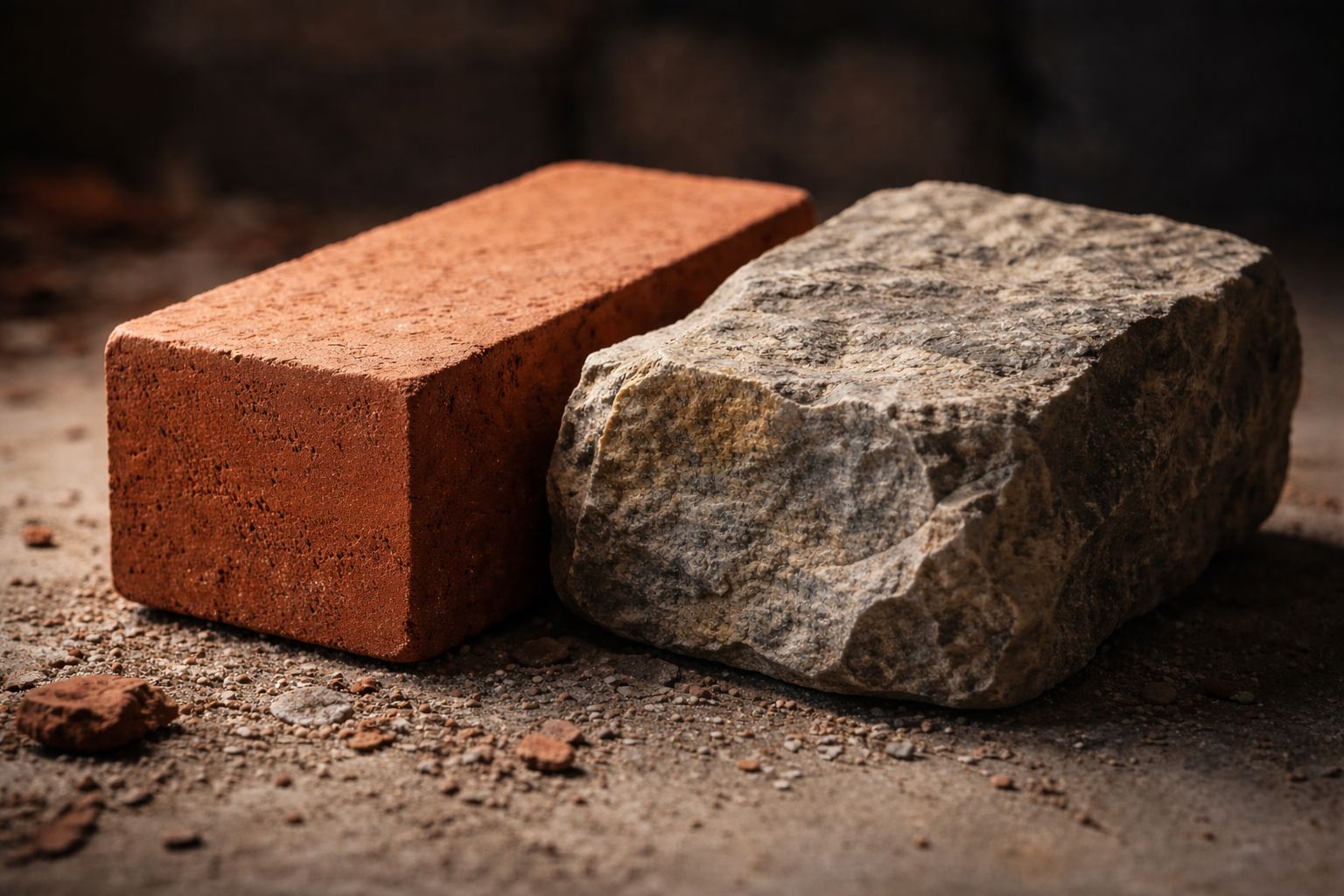
The world wants you uniform. Predictable. Replaceable.
Measured by output. Valued for conformity.
A brick in someone else's system.
But God didn't make you that way.
He formed you through pressure, over time, with intention.
Unique. Irreplaceable. Structural.
A stone.
And there's a reason the Bible keeps coming back to this image.
What Stone and Brick Actually Are
Before we get to scripture, let's talk about science.
Not because science validates scripture…scripture doesn't need validation.
But because the more we understand how things are actually formed, the more scripture makes sense. At least to me.
Romans 1:20 says God's invisible attributes are "clearly seen, being understood by the things He has made."
We're not discovering new truth. We're catching up to what an infinite God already knew.
Stone
Stone forms naturally through pressure, time, heat, and movement.
It takes geological forces—tectonic shifts, volcanic activity, erosion, compression—to create a stone. The process can take thousands or millions of years.
No two stones are identical. Each one carries the marks of its formation. The cracks. The colors. The density. The shape.
And here's what's remarkable: strength increases through stress. The more pressure a stone endures, the harder it becomes.
Stone cannot be mass-produced. You can't manufacture it. You can only work with what already exists.
Brick
Brick is man-made.
You take clay or mud. You shape it with your hands or press it into a mold. Then you fire it in a kiln to harden it.
Bricks are designed for uniformity and replacement. Same size. Same shape. Same function.
If one breaks, you swap it out. No loss. No disruption.
Brick is efficient. Predictable. Controllable.
The Difference
Stones are formed.
Bricks are manufactured.
And that difference shows up everywhere in scripture.
The Biblical History of Stone and Brick
Brick: The Material of Empires
The first time brick shows up in the Bible, it's tied to human ambition.
Genesis 11:3-4 (NKJV):
"Then they said to one another, 'Come, let us make bricks and bake them thoroughly.' They had brick for stone, and they had asphalt for mortar. And they said, 'Come, let us build ourselves a city, and a tower whose top is in the heavens; let us make a name for ourselves, lest we be scattered abroad over the face of the whole earth.'"
Notice the language: "Let us make bricks."
Not gather stones. Not work with what God provided. Make.
They wanted control. Uniformity. A monument to their own name.
Brick represents human ambition, centralized control, and the desire to dominate outcomes. Making bricks means reshaping reality to fit your plan.
Gathering stones means working with what God has already formed.
Fast forward to Egypt.
Exodus 1:13-14 (NKJV):
"So the Egyptians made the children of Israel serve with rigor. And they made their lives bitter with hard bondage—in mortar, in brick, and in all manner of service in the field. All their service in which they made them serve was with rigor."
Pharaoh didn't just enslave the Israelites. He turned them into brick-makers.
He demanded quotas. Production. Output.
He measured their worth by how many bricks they could produce in a day.
Exodus 5:7-8 (NKJV):
"You shall no longer give the people straw to make brick as before. Let them go and gather straw for themselves. And you shall lay on them the quota of bricks which they made before."
Brick becomes the symbol of oppression, exhaustion, and forced conformity.
Pharaoh didn't care about their stories. Their identities. Their individuality.
He cared about production.
Stone: The Material of God's Covenant
Now look at how God uses stone.
Genesis 28:18 (NKJV):
"Then Jacob rose early in the morning, and took the stone that he had put at his head, set it up as a pillar, and poured oil on top of it."
Jacob's pillar. A stone. A marker of covenant. A place where God spoke.
Exodus 20:25 (NKJV):
"And if you make Me an altar of stone, you shall not build it of hewn stone; for if you use your tool on it, you have profaned it."
God says: Don't cut the stone. Don't reshape it. Don't impose your design on it.
This is the opposite of what Pharaoh demanded. Pharaoh wanted bricks shaped by human hands, measured by human quotas, serving human ambition.
God wanted uncut stone—untouched by human control, accepted as it was formed.
The connection?
Pharaoh's system demanded production, quotas, and control. God's system demanded surrender, trust, and reverence.
Bricks represent forced conformity under oppression. Uncut stone represents worship without human interference.
God rejects human reshaping of what He has already formed.
1 Kings 6:7 (NKJV):
"And the temple, when it was being built, was built with stone finished at the quarry, so that no hammer or chisel or any iron tool was heard in the temple while it was being built."
The temple—God's dwelling place—was built with stone. And it was so sacred that they finished the stones before bringing them to the site. No tools. No noise. No reshaping.
Stone = covenant, worship, identity, permanence.
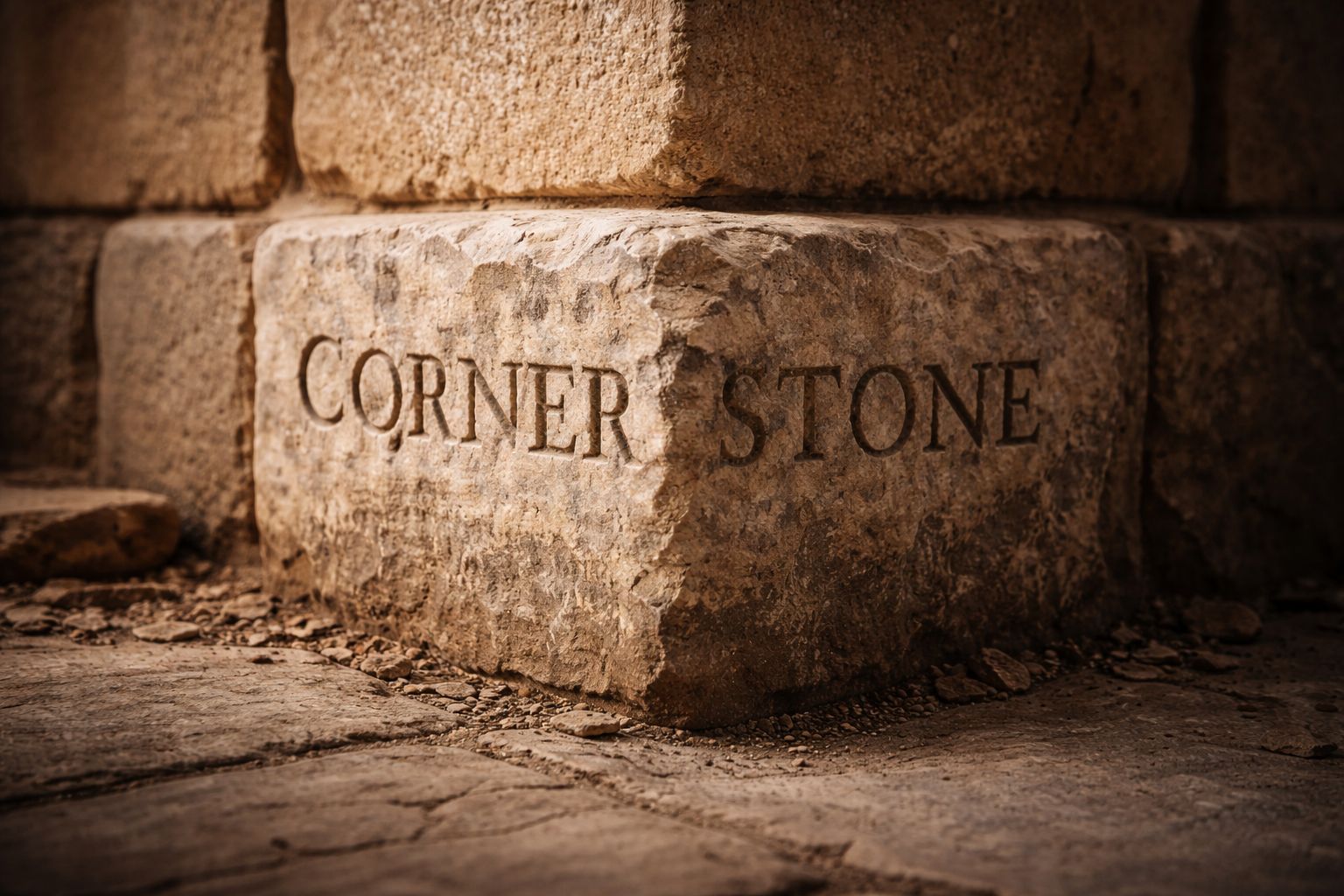
And then there's the cornerstone.
Psalm 118:22 (NKJV):
"The stone which the builders rejected has become the chief cornerstone."
Isaiah 28:16 (NKJV):
"Therefore thus says the Lord God: 'Behold, I lay in Zion a stone for a foundation, a tried stone, a precious cornerstone, a sure foundation; whoever believes will not act hastily.'"
The builders rejected the stone. Why?
Because it didn't fit their design. Their expectations. Their system.
Builders prefer predictable materials. Uniform bricks. Stones that fit the plan.
But God chose a stone that disrupted the whole structure. A stone that redefined everything.
That stone is Christ.
The Cornerstone: What It Means and Why It Matters
If you've never thought about what a cornerstone actually does, here's what you need to know:
The cornerstone is the reference point.
In ancient construction, the cornerstone was the first stone laid. It was placed at the corner of the foundation, and every other stone in the building was aligned to it.
If the cornerstone was off—even by a few degrees—the entire structure would be unstable. Walls wouldn't line up. The building would collapse.
The cornerstone defines truth, direction, and purpose for everything built upon it.
That's why the New Testament keeps coming back to this image.
Ephesians 2:19-22 (NKJV):
"Now, therefore, you are no longer strangers and foreigners, but fellow citizens with the saints and members of the household of God, having been built on the foundation of the apostles and prophets, Jesus Christ Himself being the chief cornerstone, in whom the whole building, being fitted together, grows into a holy temple in the Lord, in whom you also are being built together for a dwelling place of God in the Spirit."
Christ is the cornerstone. Every stone in God's house aligns to Him.
1 Peter 2:4-5 (NKJV):
"Coming to Him as to a living stone, rejected indeed by men, but chosen by God and precious, you also, as living stones, are being built up a spiritual house, a holy priesthood, to offer up spiritual sacrifices acceptable to God through Jesus Christ."
You are a living stone.
Not a brick. Not mass-produced. Not replaceable.
A stone. Uniquely formed. Placed intentionally. Aligned to Christ.
The Spiritual Picture
1 Peter 2:5 (NKJV):
"You also, as living stones, are being built up a spiritual house, a holy priesthood, to offer up spiritual sacrifices acceptable to God through Jesus Christ."
God is not constructing a factory. He is constructing a house.
A factory prioritizes output and efficiency. A house prioritizes relationship, presence, and permanence.
Every stone in God's house is:
Uniquely shaped by the pressure it endured
Placed intentionally where no other stone can function
Supported by Christ the cornerstone
Your life makes sense when aligned to Christ. Your strength multiplies when you build on Him.
Your Uniqueness Is Structural
God needs your exact shape in His house.
Not a version of you that fits someone else's mold. Not a manufactured copy of what the world says you should be.
Your exact shape. Your exact story. Your exact placement.
Another stone cannot replace your assignment.
We live in a world that is experiencing increasing burnout, depersonalization, and the haunting sense of being easily replaceable. Systems feel heavier, faster, more impersonal.
But you are not a brick in someone else's system.
You are a stone in God's house.
And Christ is the cornerstone that gives your life its true alignment.
What pressure are you in right now that might actually be forming you into the exact stone God needs?
That’s it for today
keep JOY, live Disciplined

Reply